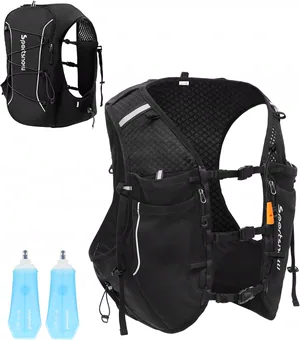
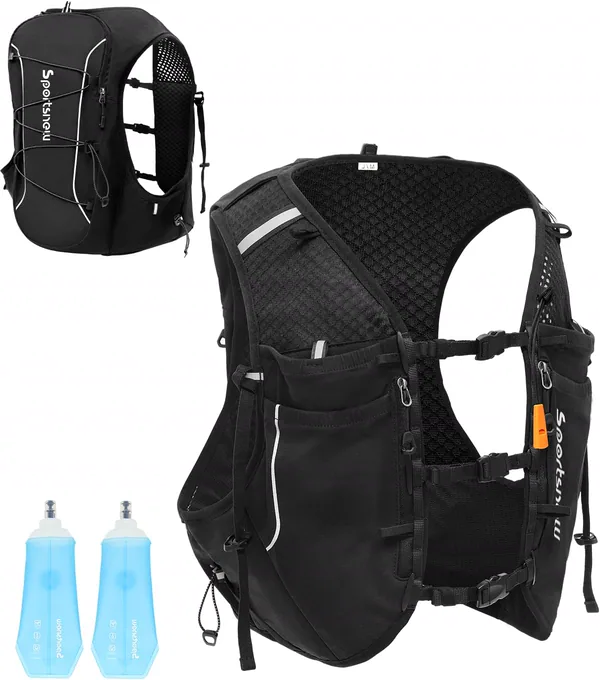
The Sportsnew 10L running hydration vest is the kind of pack you wear rather than carry. It sits high on your back like a small backpack, and its front straps are wide panels with pockets in them, so the water rides on your chest where you can reach it without stopping. This version ships with two 500 ml soft flasks in the front pockets. There is a sleeve at the back for a hydration bladder of up to 2 liters, a large zipped main compartment, and a scatter of smaller pockets for a phone, gels and keys. Sportsnew sells it at $36.99.
Who shops for a vest like this? Trail runners stepping up from a handheld bottle, road runners training for a first marathon who are tired of planning routes around water fountains, and hikers who want something lighter than a daypack. The listing names running, hiking, cycling, mountaineering and marathons, and its detail table adds skiing and snowshoeing.
The thing that decides it is how much risk you're willing to take on a thin record. The vest has 20 Amazon ratings and 4.3 stars. There are no buyer passages on the listing for us to quote, and no topic counts. The listing also leaves out the single number most runners check first, the weight. So this review rests on what the listing states, what its two images show, and what those features mean on your body. Where the listing contradicts itself, we say so.
Sportsnew 10L Running Hydration Vest
$36.99at our last price check
How the vest is laid out
A running vest has three zones, and it helps to think about each one separately: the front straps, the back panel, and the side and small pockets.
On the front, the two soft flasks are the headline. A soft flask is a collapsible bottle made of flexible plastic with a bite valve on top. It sits in an elastic pocket on each shoulder strap, and as you drink, it shrinks, so it doesn't slosh as much as a rigid bottle half full. Two 500 ml flasks give you a liter of water at chest height. On a run that is the difference between drinking when you need to and waiting for the next aid station.
At the back, the detail table lists a "2L Hydration Bladder Warchouse", a typo for a bladder compartment, and the brand story describes the product as a "Running Vest Hydration Backpack with 2L Water Bladder". A bladder is a flat reservoir with a long drinking tube. It carries more water than flasks, but you can't see how much is left, and it's slower to refill.
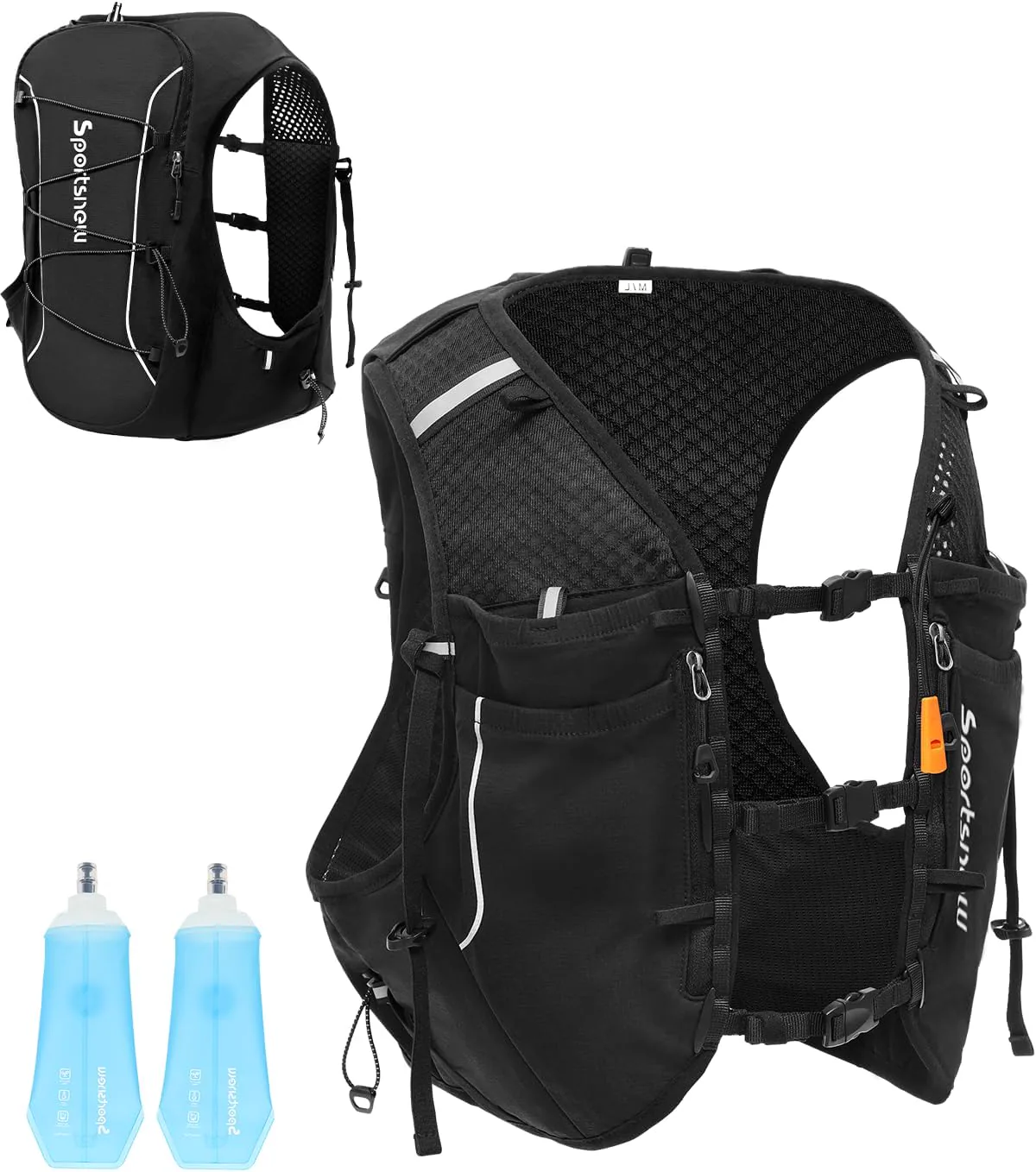
The rest of the storage, according to the pocket description, is a large zipper main compartment, a stash pocket, two utility pockets and two water-resistant phone pockets. The detail table says 12 pockets in total. If you count what the pocket description actually names, you get nine: the bladder sleeve, two flask pockets, the main compartment, the stash pocket, two utility pockets and two phone pockets. The remaining three may be small sleeves or key loops the description doesn't name. The listing doesn't say.
| Pocket, as the listing names it | Where it most likely sits | What it is for |
|---|---|---|
| 500 ml soft flask pocket, x2 | Front straps | The two included flasks |
| Water-resistant phone pocket, x2 | Front straps | A phone, and something you want dry |
| Utility pocket, x2 | Front or sides | Gels, a key, a card |
| Stash pocket | Back | A wind layer or a hat |
| Large zipper main compartment | Back | The bulk of the 10 liters |
| 2L hydration bladder compartment | Back, against your body | A bladder, if you add one |
The "most likely" column is our reading of how vests of this design are put together, combined with the flat photo. The listing doesn't publish a labelled diagram of pocket positions, so treat that column as a guide rather than a spec.
The bladder question
Here is the contradiction you need to sort out before you order. The title says "Hydration Pack with Water Bladder". The brand story says "Hydration Backpack with 2L Water Bladder". But the detail table's color name is "Black with 2 x 500ML Soft Flask", and its included components list reads "500ml Soft Flask*2". The bladder is not in that list. The main product photo shows the vest with the two flasks and no bladder.
Our reading is that the vest has a sleeve sized for a 2-liter bladder, and that this listing's version comes with the two flasks rather than a bladder. Sportsnew may sell other versions with a bladder included. If carrying 2 liters on your back is the reason you're buying, check the version you select before you pay, and expect to buy a bladder separately if the included components still say flasks only.
Fabric and build
The detail table gives the material as nylon. The bullets describe "lightweight mesh construction" that "promotes airflow and prevents overheating". Together, that suggests a nylon shell for the pockets and main compartment with mesh panels where the vest touches your back and shoulders, which is how most vests of this type are built. Mesh is the part that matters for comfort. A running vest sits against a sweaty back for hours, and solid fabric there holds heat and rubs.
What the listing doesn't tell you:
- The weight of the vest, empty or with flasks.
- The denier or weight of the nylon.
- Whether the zips are coated or water-resistant.
- What the "reflective elements" are, or where they sit on the vest.
- Care instructions of any kind.
The weight gap is the big one. Runners compare vests by grams, because every gram on your shoulders is carried for every mile. A vest that feels fine on a 5K can start to rub at hour three. With no stated weight and no buyer comments, you can't make that comparison from this listing. You'll find out when it arrives.
The title calls the phone pocket "Waterproof". The detail table calls the two phone pockets "Water-resistant". Those words don't mean the same thing. Water-resistant fabric slows down rain and sweat. Waterproof implies sealed seams and a sealed closure, which nothing in the listing describes. Plan on "water-resistant", and put your phone in a zip bag if you're running in a downpour.
Reflective trim
The fifth bullet says reflective elements make you visible in low light, for "early morning or evening runs". The flat photo is a black vest, and a black vest disappears into a dark road, so the reflective trim isn't a small detail here. The listing doesn't say how large or where the reflective parts are. If you run on roads in the dark, plan to add a light or a brighter layer rather than relying on trim you haven't seen.
Fit and sizing
The listing describes the vest as unisex, "engineered to comfortably fit both men and women". The bullets promise "customizable straps and panels" for "a secure, bounce-free fit". The product dimensions are given as 16.14 inches wide by 16.14 inches high, with no depth, which is a flat measurement of the vest laid out rather than a size you'd wear.
Sportsnew includes a size guide as the second listing image. Its caption on our side reads as a guide by chest and height. The figures themselves are only in the image, not in the listing text, so read the chart on the product page before you order and measure your chest at the widest point over the layer you'd usually run in.
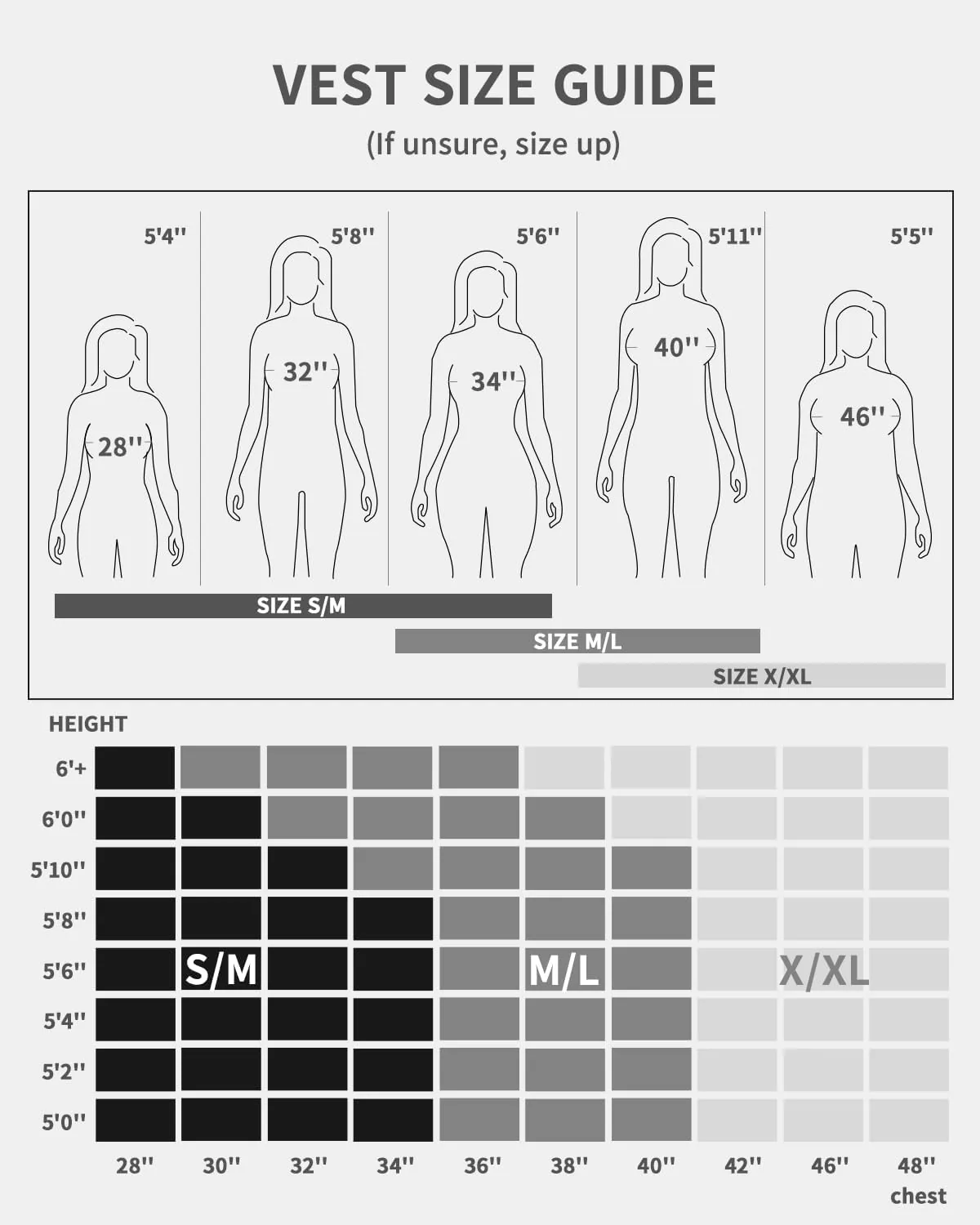
Because the listing names no sizes in its text, we can't tell you whether the vest comes in one adjustable size or several. What we can do is translate the general rules of vest fit into what to look for on this one.
| What to check when it arrives | Why it matters on a run |
|---|---|
| The front straps sit flat across your chest | Gaps let flasks swing and the vest bounce |
| The flasks sit high, near your collarbones | Low flasks hit your ribs with every stride |
| The back panel ends above your waistband | A long back rubs the small of your back |
| Side adjusters still have slack left when it's snug | You need room to loosen over a jacket in winter |
| Nothing digs under your arms with arms swinging | Underarm rub is the most common vest complaint |
Bodies change the picture. On a shorter torso, a vest cut for a 16-inch back can reach the hips and press on the waistband of your shorts. On a broad chest, flasks on the front straps can sit on top of the chest rather than beside it, which bothers some women and not others. A unisex vest is a compromise for both. With no buyer comments to tell us how this one lands on different bodies, the fit check above is your best tool, and keeping the packaging until you've done a test run is sensible.
Carrying capacity in practice
Ten liters is a medium size for a running vest. It is enough for water, a wind jacket, a hat, gloves, a phone, keys and a few gels, which covers most long training runs and half-day hikes. It's not enough for a full lunch, a warm insulated jacket and a first aid kit all at once. That's daypack territory.
Water adds up quickly. Two full 500 ml flasks are a liter, a little over two pounds of water on your chest. Add a 2-liter bladder at the back and you are carrying three liters, well over six pounds of water before the vest and your gear. That is a lot for a running vest, and it's why most runners use either the flasks or the bladder on a given day, not both. On a two-hour summer run you might want the flasks only. On a long hike with no water sources, the bladder earns its place.
| Setup | Water carried | Good for |
|---|---|---|
| Two included flasks | 1 liter | Runs up to a couple of hours with a refill |
| One flask | 500 ml | Short runs, cold days |
| Bladder in the back sleeve, bought separately if needed | Up to 2 liters | Long hikes and hot days with no refill |
| Flasks plus bladder | Up to 3 liters | Long, remote days, at a real weight cost |
The listing says "bounce-free" in its third bullet. That's a claim about fit rather than a measurement, and it depends on how full the vest is and how well you adjust it. A half-empty bladder sloshes in any vest.
Drinking on the move
The practical case for front flasks is how you drink. You reach up, pull the bite valve to your mouth, squeeze, and push it back down, all without breaking stride. With a bottle in a hip belt you twist. With a bladder you pull a tube off the strap and have no idea how much is left until it sucks air. The two included flasks put the water in the easiest place to reach, which is the main reason runners choose this layout.
Two habits make the setup work better. First, fill the flasks right to the top and squeeze the air out before you close them, since an air pocket is what makes a soft flask slosh. Second, practice putting a flask back in its pocket at a walk before you try it at pace. Elastic flask pockets are snug on purpose, and a half-empty flask is floppy. The listing doesn't describe the pocket opening or whether there's a bungee or cord to hold the flask in, so this is something to look at when it arrives.
The flasks also tell you something about your pacing. A liter split across two flasks lets you drink one in the first half of a run and the second later, and you can see and feel which one is empty. That's harder with a bladder, where the only gauge is weight on your back.
If you plan to refill on a route, at a fountain or an aid station, the flasks are also quicker. A soft flask fills in seconds from a tap or a jug. A bladder has to come out of its sleeve, which usually means taking the vest off.
The brand behind it
Sportsnew is better known for carriers than for running gear. Its range runs from crossbody slings for 30 and 40 oz tumblers and magnetic bottle bags to puffy yoga mat bags, gym totes, pickleball slings, waist packs and makeup bags. A running vest is a natural step for a brand that makes bottle carriers, but it's a more demanding product: a sling hangs at your side for an hour of walking, while a vest is strapped to you at running pace for an afternoon. The listing's brand story leans on lines like "Run light Run free" rather than on specifications, which is another reason to judge the vest on arrival rather than on the page.
Care
The listing gives no care instructions for the vest or the flasks. As a general habit with any hydration gear, rinse soft flasks and any bladder after every use, let them dry fully with the caps off, and hand wash the vest itself. Those are our general suggestions, not the brand's. Sportsnew doesn't say whether the flasks are dishwasher safe or what plastic they are made of, so don't assume either.
What buyers say
The rating is 4.3 stars from 20 buyers. That sample is small enough that a couple of reviews move the average a lot. The breakdown is 65% five stars, 12% four stars, 12% three stars and 11% two stars, with no one-star ratings. In a sample of 20, that 23% of two- and three-star ratings likely amounts to four or five people.
The listing shows no buyer passages, no topic counts and no buyer photos, so we cannot tell you why those buyers were less happy, and we won't guess.
It's worth being clear about what a small sample can and can't tell you. Thirteen or so five-star ratings say the vest arrived and suited most of the people who bought it early. They say nothing yet about how the flask pockets, zips and mesh hold up after a season of weekly long runs, because a listing this new hasn't had a season. A vest with a few thousand ratings has had its weak points found and written about. This one hasn't, which is why our Buyers score stays below what a 4.3 would earn on a long record. If you buy it, your own review will be one of the first that later shoppers read. The listing also shows no "bought in past month" figure.
The video on the listing comes from Sportsnew itself, so it shows the vest the way the brand wants it seen rather than how buyers find it.
How it compares
We searched Amazon for running hydration vests. Several of the results are the same products listed more than once, so we've kept one row for each.
Prices, ratings and monthly purchase counts as shown on Amazon search results on November 14, 2026. Highlighted rows are the products reviewed here.
The table tells a clear story about evidence. The best-selling budget vests in it have from several hundred to more than 2,600 ratings, at between 4.3 and 4.5 stars. The Sportsnew's 4.3 sits in the same range, but it rests on 20 ratings rather than thousands. Several competitor titles state their bladder size in the title, 1.5 or 2 liters, which suggests the bladder comes with them. The Sportsnew title does the same, but its own included components list says otherwise, as above.
At the other end, the Osprey Duro LT costs roughly three times as much and has 57 ratings. Its title names soft flasks too, so it's in the same front-flask family, from a brand with long experience in packs. We have no data in the listing on its weight or capacity, so we can only say what the title and the numbers say.
| If you want | The Sportsnew |
|---|---|
| Two flasks in the box | Yes, two 500 ml |
| A bladder in the box | Unclear, the listing contradicts itself |
| A stated weight | No |
| Reflective trim | Yes, details not given |
| A long buyer record | No, 20 ratings |
| A price in the budget band | Yes |
For runners who don't need to carry this much, a belt or a short is often enough. Our BMJL 2.5-inch athletic shorts review covers a short with a zipped phone pocket, and the rest of our activewear section has more running gear.
Who should buy it
You should consider it if you run or hike for long enough that a handheld bottle isn't enough, you want water on your chest rather than at your hip, and you like the idea of flasks now with the option of a bladder later. The layout on paper is the right one: two front flasks, a bladder sleeve, a zip main section for a layer, phone pockets on the front and reflective trim. And it comes in at a price where the downside of a poor fit is a return, not a lost investment.
It also suits someone who has worn a front-flask vest before and knows exactly how one should sit. You'll be able to judge the fit in your hallway in five minutes, which matters more here than on a vest with thousands of reviews to lean on.
Who should skip it
Skip it if you want a vest with a proven record on long runs. Twenty ratings and no buyer passages tell you very little, and nearly a quarter of those ratings are two or three stars. Skip it if weight matters to you and you want to compare grams before you buy, because the listing doesn't give one. Skip it if the bladder is the point and you don't want to order a second item. And if you run on roads at night, don't rely on reflective trim you haven't seen.
You can see the vest and Sportsnew's description on the brand's page for the running hydration vest.
Verdict
The Sportsnew 10L vest has a sensible design and two flasks in the box, at a price that sits with the budget favorites. We recommend it, cautiously, for runners and hikers who know what a vest should feel like and are happy to judge it on arrival. We don't recommend it if you need a stated weight, a long buyer record or a guaranteed bladder in the box. Read the size chart, check the version, and run a lap of the block before the return window closes.
A sensible layout on a thin record
On paper the Sportsnew vest has the layout trail runners look for: two front soft flasks, a sleeve for a 2-liter bladder, a zip main section and reflective trim. What it lacks is evidence. Twenty ratings, no buyer passages to read, no stated weight and a listing that disagrees with itself about whether a bladder is in the box.
- Two 500 ml soft flasks included, carried on the front straps
- Rear sleeve for a hydration bladder up to 2 liters
- 10-liter capacity with a large zipped main compartment
- Reflective elements for early and late runs
- Priced in the same band as the best-selling budget vests
- Only 20 ratings, and 23% of them are two or three stars
- The listing never states the vest's weight
- Title promises a water bladder, but the included components list only the two flasks
- Phone pocket is called waterproof in the title and water-resistant in the details
- No care instructions and no fabric detail beyond nylon and mesh
Best for: Runners and hikers who want a front-flask vest with room for a bladder and a layer, and who are comfortable being an early buyer.
Skip it if: You need a stated weight and a long buyer record before you trust a vest on a long trail day, or you expect a bladder in the box.
Where the numbers come from. Prices, star ratings, rating counts and monthly purchase badges were read from the product pages on November 14, 2026; they move daily. Fabric, sizing and dimensions come from the product specifications. See how we review.