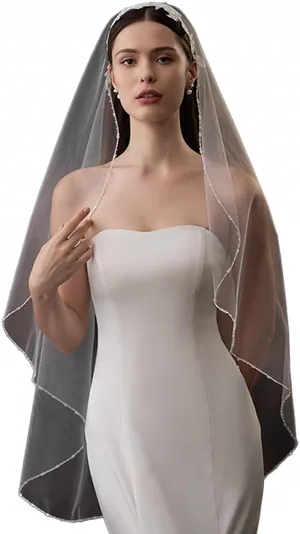
A wedding veil is one of the few things on a bridal checklist that you buy without trying, often online, and usually close to the date. The Kokoma Beaded Edge Fingertip Bridal Veil is a single layer of white tulle on a hair comb, cut to what the trade calls fingertip length, with a row of beads running along the border. It sells for $14.99, which puts it at the low end of what brides spend on the item.
Its shoppers are easy to picture. A bride with a plain or lightly beaded gown who wants a veil for the ceremony and the photos, not a cathedral train. Someone planning a courthouse wedding or a vow renewal who still wants a veil in the pictures. A maid of honor buying a backup veil in case the expensive one goes wrong on the day. All of them want the same thing: a veil that looks finished in photos and does not fight the dress.
The deciding fact here is not the bead count or the tulle. It is that this listing has no ratings. Not a low rating, none at all, and no buyer reviews, buyer excerpts or buyer photos either. Everything we can tell you comes from the title, the five bullets, the detail table, the care line and two photos. That is enough to judge the design and to spot two places where the listing contradicts itself. It is not enough to say how the tulle feels, how the beads hold or whether the white matches your dress. You will find that out when the packet arrives, so plan your timing around it.
One tier, one comb and a beaded border
The construction is about as simple as a veil gets. There is one tier, which means a single layer of tulle that hangs from the comb to the hem, with no shorter blusher layer to pull forward over your face. A two-tier veil gives you that blusher, and it also adds volume at the top of the head. With one tier you get a flatter, more see-through fall, which works well with a structured bodice you want people to see through the tulle. If you want the moment where someone lifts the veil off your face, this is the wrong style, and the brand sells two-tier versions for that.
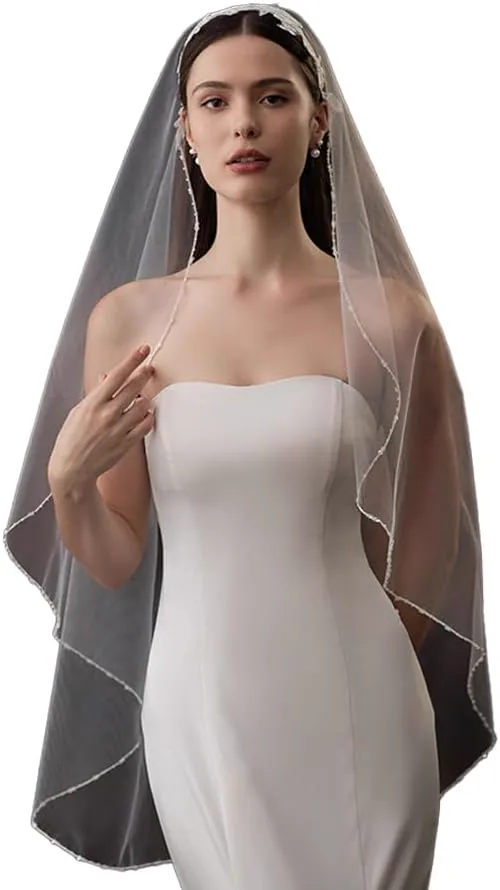
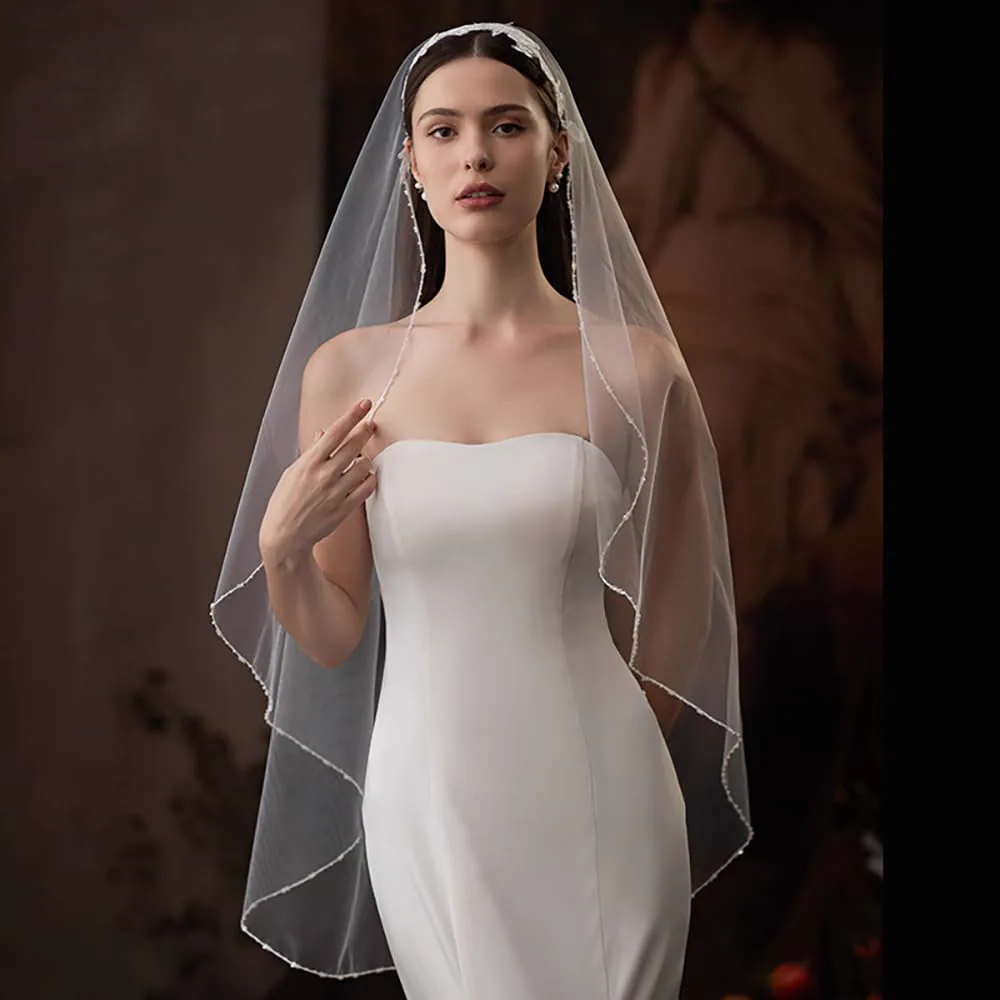
Most of the listing's words go to the border. The first bullet calls it "a delicate beaded edge trim", and the second says the edging "creates a subtle shimmer". On a veil, beads at the hem do two practical things beyond looks. They give the edge a little weight, so the tulle hangs straighter instead of floating up in a breeze. And they define the outline of the veil in photographs, where plain tulle can disappear against a white dress. The front photo shows the beaded line falling past the shoulders and framing the bodice.
What the listing does not tell you is how the beads are attached, how far apart they sit, what they are made of or how many there are. There is no close-up in the two listed photos. So the word "beaded" covers a wide range here, from a dense line of seed beads to occasional pearls spaced inches apart. The second photo is described simply as the beaded edge veil worn from the front, and that is the best evidence there is.
The comb
The fifth bullet promises "a sturdy hair comb attachment that keeps the veil perfectly positioned". The listing gives no comb width, no tooth count and no material. That matters more than it sounds. A narrow comb with few teeth holds well in thick, textured hair and slips in fine, straight hair. If your hair is fine or freshly washed, ask your stylist to build a small anchor (a few crossed pins or a tight section) for the comb to bite into, or plan to add your own pins through the comb. The listing will not tell you which kind of comb you are getting, so treat it as unknown.
What the listing says it is made of
Three fields describe the material, and they do not quite agree.
| Where on the listing | What it says |
|---|---|
| Title | "White Tulle 1 Tier Fingertip Length" with a "Dainty Beaded Edge" |
| Bullets | "soft white tulle material" with "beaded edge trim" |
| Material Type | Nylon Mesh, Polyester, Tulle |
| Fabric Type | Soft Tulle With Beaded Edge Trim And Lace Appliques |
| Style Name | Fingertip Length Beaded Edge |
| Pattern | Solid |
| Photo captions | Fingertip tulle veil worn, front; beaded edge veil worn, front |
The odd one out is "Lace Appliques". Nothing else on the page mentions lace. The title doesn't, the bullets don't, the style name doesn't, and neither photo description mentions lace motifs. The brand sells other veils with lace (its own listing shows a cathedral veil with floral lace embroidery and a two-tier veil with lace appliques), so the most likely story is that a field was copied from a sister product. If you are buying this veil because you want a clean beaded edge and no lace, that is probably what you will get. If you want lace, buy a veil whose title says lace.
Material Type also names nylon mesh and polyester as well as tulle. Tulle is a construction, a fine net, rather than a fiber, and bridal tulle is commonly made from nylon or polyester. The listing does not say which fiber the net is, or whether the beads are glass, acrylic or plastic. It does not give a stiffness either. Soft tulle drapes close to the body, and stiff tulle stands away from it. The bullets call this one "soft" and "lightweight", and say it "drapes beautifully", so expect a veil that falls flat and follows your back rather than one that puffs out from the head.
How long is fingertip length on you
The third bullet gives the only measurement on the listing: the veil "extends gracefully to approximately 36-40 inches". Fingertip is a traditional name for where the hem lands when you stand with your arms relaxed at your sides. The name assumes an average bride and an average comb placement. Neither of those is you.
That figure is measured from where the veil gathers at the comb. So the single biggest thing that moves the hem is where you put the comb. A comb pushed in high at the crown starts the drop near the top of your head. A comb tucked under a low bun at the nape starts it several inches lower, and the hem drops by the same amount. Your height and arm length do the rest. On a tall bride, a 36 inch drop from the crown can end at the hip rather than the fingertips. On a petite bride, a 40 inch drop from a low bun can reach mid-thigh.
| Comb placement | Where the 36 to 40 inch drop starts | What it tends to do on the body |
|---|---|---|
| High at the crown | Top of the head | Shortest finish; on taller brides the hem may land at the hip |
| Middle of the back of the head | A few inches lower | Closest to the classic fingertip look on an average height |
| Under a low bun at the nape | Base of the skull | Longest finish; on petite brides the hem can reach mid-thigh |
| Into a half-up style | Varies with the hair section | Check the drop with the hairstyle done, not with hair down |
Two practical consequences follow. First, do the tape measurement with the hairstyle you will actually wear, or at least with your hair pinned up the way you plan. Second, think about the dress. A fingertip veil ends near the widest part of many ball gown skirts and mermaid flares. If your skirt kicks out right at the hip, a veil that ends there will lie on top of the skirt and spread, which some brides like and some don't. On a slim sheath or slip dress, the same length reads as a long vertical line down the back.
The listing does not give the width of the tulle. Width decides how much the veil wraps around your shoulders and how full it looks from behind. A narrow veil reads as a ribbon of tulle down the spine, and a wide one wraps the arms. The front photo shows the tulle falling to both sides of the shoulders, so it is wide enough to frame the upper body, but there is no number to compare against other veils.
Color: white, and only white
The Color field says White and the title says White Tulle. That is it. Bridal fabrics come in several shades that all get sold as white: bright white, soft white, diamond white, ivory, champagne. A bright white veil over an ivory gown can make the dress look yellow by comparison, and the difference shows in flash photography more than it does in a mirror.
This listing gives you no shade options and no description of the shade beyond "White". If your dress is anything other than bright white, hold the veil against the dress in daylight the moment it arrives. The brand does sell ivory veils (one is shown on its own listing comparison), so if this white is wrong you have somewhere to go within the same brand.
The beads matter here too. Clear or silver beads read neutral against any white. Pearl beads have their own tone and can look cream next to a stark white gown. The listing does not say which kind of bead is on the edge, so look at the beads as well as the tulle when you do the daylight check.
Care, storage and the folds it arrives with
Unusually for a budget veil, the listing spells out its care rules. Here they are, with what each one means in practice.
| Care instruction on the listing | What it means for you |
|---|---|
| Hand Wash Only | Don't put it in a machine, even in a mesh bag, where a drum is rough on fine net and sewn beads |
| Lay Flat To Dry | Spread it on a towel; hanging wet tulle can stretch at the comb |
| Store Hanging | Keep it on a hanger or over a door until the day, not folded in a drawer |
| Avoid Direct Sunlight | Keep it out of a sunny window while it hangs |
| Do Not Iron Directly On Beading | Any pressing has to stay off the beaded border |
The package dimensions explain why the hanging instruction matters. The listing gives the package as 3.54 by 2.76 by 0.2 inches, weighing 0.18 ounces. That is a flat packet smaller than a phone. A veil that drops up to 40 inches has to be folded many times to fit in it, so it will arrive with fold lines. Hanging it as soon as it arrives gives the creases time to relax before the wedding, and it is the brand's own storage advice anyway.
Weight is worth noticing for another reason. At 0.18 ounces for the whole package, this is a light veil. Light tulle moves in wind. If you are marrying outdoors, by the sea or on a hillside, a veil this light will lift and blow across your face in a breeze. The beaded edge adds a little weight at the hem, but there is no way to tell from the listing how much. Ask your photographer or a bridesmaid to keep a few pins handy, or consider a heavier or longer veil for a windy site.
Of the five rules, the ban on ironing the beading is the one most likely to be broken on the morning of the wedding. If someone reaches for a hot iron to deal with a fold, the heat can melt synthetic tulle in seconds and can damage plastic beads or their thread. The listing forbids ironing on the beads and says nothing else about pressing, so the safest course is to rely on hanging and time rather than heat.
What buyers say
There is nothing to report here, and that absence is the most important fact about this veil. At the time of writing, the listing shows no star rating, no rating count, no buyer reviews and no buyer photos. It also shows no "bought in past month" figure. Amazon has not generated topic summaries for it either, because there are no reviews to summarize.
That does not mean the veil is bad. It usually means a listing is new. But it changes how you should buy it. With a product that has thousands of ratings, the star histogram tells you how often people get a dud, and the complaints tell you what the dud looks like (thin tulle, loose beads, a yellow cast, a comb that falls out). Here you have none of that. You are the first reviewer.
The listing itself shows that this is not unusual for the brand. Its comparison chart puts this veil next to several other Kokoma veils, and their rating counts are in single digits: four ratings, one, one and two. Bridal veils sell to people who wear them once, and many buyers never come back to rate them. So the empty review section is a property of the whole category on Amazon as much as of this item.
What you can do is build in time. If you order three or four months before the wedding, you can inspect the veil, try it with the dress and the hair trial, and return or replace it if the shade, the beads or the comb disappoint you. If you order three weeks out, you are taking a real risk on a product nobody has reported on.
How it compares
We searched Amazon for one-tier fingertip veils with a beaded edge. These are the listings that came up, with their prices, star ratings and rating counts.
Prices, ratings and monthly purchase counts as shown on Amazon search results on November 14, 2026. Highlighted rows are the products reviewed here.
The table puts the Kokoma veil in context quickly. Its price, $14.99, sat near the bottom of the range when we pulled the search. The only veil that undercut it then had three ratings. The listings with real buyer histories are the ones near the top: a one-tier fingertip veil with pearls and a beaded edge has 685 ratings at 4.5 stars and 200+ bought in the past month, and a one-tier veil with a comb and a pearl beaded edge has 341 ratings at 4.4 stars. Both cost more than the Kokoma veil.
So the choice the table sets up is fairly clear. You can pay less and buy a veil with no record, or pay more and buy one that hundreds of people have already rated around 4.5 stars. A 4.4 to 4.5 average across several hundred ratings on a veil suggests most buyers got what they expected, although you would still want to read their complaints before ordering.
Notice also what the competitor titles promise. Most of them name pearls, crystals or both along the edge. The Kokoma title says only "beaded". If you specifically want pearls on the border, the Kokoma listing does not promise them, and you should pick a veil whose title does.
Two other details in the search are worth a glance. Several competitors put "with Comb" in their titles, which tells you a comb is standard in this category rather than a bonus. And every alternative with a full title is one tier, which means the search compares like with like: single layer, fingertip length, beaded edge.
Who should buy it, and who should wait
This veil makes sense for a specific kind of buyer. You want a classic one-tier shape. Your dress is bright white or close to it. You like a defined edge but don't need lace or pearls. You are ordering early enough to try it on and return it. And you would rather spend the difference on something else in the wedding budget. If all of that describes you, the Kokoma veil is a sensible thing to order and look at.
It also makes sense as a backup. Brides who have a pricier veil from a bridal shop sometimes keep an inexpensive second one for the reception, the dance floor or a rainy outdoor portrait session where they don't want to risk the good one. A light fingertip veil at this price fills that role, and if it gets snagged nobody is heartbroken.
If you are shopping for a matching hair piece or a rhinestone belt to go with the dress, we have also looked at Abien's rhinestone stretch belt and light-up headbands, and the rest of our accessories coverage lives in the accessories section.
Skip it, or at least look harder, in these cases:
- Your dress is ivory, champagne or blush. The listing offers only White and does not describe the shade.
- You want lace. The title, bullets and photos describe a beaded edge only, and the one field that mentions lace looks like a copy error.
- You need a blusher layer to wear over your face. This is a single tier.
- Your wedding is outdoors in a windy spot. A veil this light will lift.
- You are ordering late. With no buyer reports, you need time to inspect and possibly return it.
- You want reassurance from other buyers. Pick one of the higher-rated listings in the comparison instead.
Before you order, it is worth reading the Kokoma product page for this veil on the brand's own site, in case it carries details the Amazon listing leaves out, such as comb width or bead type.
Verdict
The Kokoma Beaded Edge Fingertip Bridal Veil is a plain, classic design at a low price. One layer of white tulle, a beaded border, a comb, and a stated 36 to 40 inch drop that lands at fingertip length on an average frame with the comb at the back of the head. The care instructions are clear and sensible, which is more than many budget veils manage.
Its problems are informational rather than obvious faults. There are no ratings and no buyer reports, so nobody has told the next shopper whether the beads stay on or the white looks bright or grey. The detail table mentions lace appliques that nothing else on the listing supports. And there is only one shade.
We recommend it for brides who want a simple bright white fingertip veil, have measured their drop from the comb, and are ordering with enough time to return it. We don't recommend it if you need ivory, need lace, need a blusher, or are buying close to the date and want a veil that hundreds of buyers have already rated. In that case, pay a little more for one of the better-reviewed veils in the comparison.
A reasonable budget veil you buy on the listing alone
The Kokoma veil is a classic shape at a low price: one tier, fingertip length, a beaded border and a comb. It has no buyer record at all, and its own listing disagrees with itself about lace, so order early enough to send it back.
- Classic one-tier fingertip shape that suits most dress styles
- Beaded border gives the edge some weight and catches light in photos
- Care instructions are actually written out on the listing
- Comb attachment included, so no separate clip is needed
- No Amazon ratings or buyer reviews at all
- Detail table mentions lace appliques that the title and photos do not show
- Shade is listed only as White, with no ivory or diamond white option on this listing
- Ships folded in the listing a few inches wide, so expect creases
Best for: A bride or second-wedding shopper who wants a plain fingertip veil with a little sparkle at the hem and has time to order, inspect and return.
Skip it if: Your wedding is days away, your dress is ivory or champagne, or you want a veil other buyers have already vouched for.
Where the numbers come from. Prices, star ratings, rating counts and monthly purchase badges were read from the product pages on November 14, 2026; they move daily. Fabric, sizing and dimensions come from the product specifications. See how we review.